Payment Orchestration
One checkout can connect to more than one payment path.
We help you evaluate whether orchestration adds useful control over your payment connections.
Your customer sees one checkout. You manage the connections behind it.

Orchestration
Approved routing rules
Processor A
U.S. orders
Processor B
European orders
Processor C
Supported alternate route
One customer experience. More control behind the scenes.
Illustrative setup. Routes depend on approved provider relationships, integrations and business rules.
How orchestration works.
Follow an order. See which rule selects an eligible payment route.
Follow an order
Illustrative demo
Example sneaker order
- Country
- United States
- Currency
- USD
- Payment method
- Card
Orchestration
Approved routing rules
U.S. order · USD · Eligible account
- Selected
Processor A
Processor B
Processor C
Supported alternate route
Why this route?
The order matches the configured U.S. routing rule. Processor A is eligible in this example.
Orchestration
Selects the route and coordinates integrations.
Processor / acquirer
Processes payments through the approved relationship.
Merchant account
Defines the approved processing relationship.
Routing rules and requirements
Business structure
Approved merchant account, business entity, brand or website.
Market and payment
Country, currency, transaction type, payment method or card characteristics where permitted.
Availability
Processor availability across supported, approved payment paths.
Orchestration does not replace merchant underwriting or acquiring relationships. Routing capabilities depend on processor agreements, contracts, underwriting, card-network requirements, technology and merchant setup. Never use routing to disguise merchant activity or work around processor, issuer or network controls.
The unavailable-provider scenario illustrates a provider outage, not an issuer-decline bypass. It makes no payment success or approval claim. Alternate routes require approved relationships, supported integrations and order eligibility.
Illustrative demo. Routes depend on approved relationships, supported integrations and business rules. Orchestration does not replace underwriting.
No architecture guarantees uninterrupted acceptance.
When is orchestration worth it?
Match the safeguards to your payment dependence, complexity and cost.
Advanced orchestration
More connections. One place to manage them.
For businesses coordinating multiple approved processors, merchant accounts (MIDs) or markets.
- Centralized integrations and routing rules
- Provider comparison and reporting
- Supported alternate payment paths
May improve approvals and recover eligible failed payments. Results require measurement.
Your payment environment
Orchestration platform
Configured rules
Processor A
Processor B
Processor C
What to weigh
Platform & integration costs
Support & ongoing upkeep
Expected measurable benefit
Use cases, costs and requirements
Where control may help. Multiple processors, acquirers or MIDs across entities, brands, websites and transaction flows; international growth, different markets and complex subscriptions; supported redundancy and eligible performance comparison.
What control costs. Platform fees, integration and development, technical dependencies, provider management, reporting and reconciliation, support, maintenance and operational complexity as the environment changes.
If one processor and one gateway solve the problem well, orchestration may add unnecessary cost and complexity. Evaluate payment dependence and expected measurable benefit—not volume alone.
Capabilities depend on approved provider relationships, contracts, underwriting, card-network requirements, supported technology and merchant setup. AI-assisted routing requires suitable integrations, reliable data and oversight. Never disguise activity, bypass issuer or network controls, or retry indiscriminately.
How much would an hour without payments cost your business?
Volume matters. So do lost sales, customer experience and operational impact.
Illustrative approaches. Basic continuity may be enough for a new store. Intelligent routing needs suitable integrations and reliable data. No setup guarantees approvals or uninterrupted processing.
Plan for interruptions
Your store is open.
What if your checkout isn’t?
A provider outage can leave customers ready to buy—with no way to pay.
One payment path

Your checkout is stuck.
One connection. No prepared alternative.
A planned alternate

Another eligible path is ready.
Supported routing can reduce dependence on one provider.
Know what’s behind your backup.
Two MIDs don’t necessarily mean two independent payment paths.
MID A
Merchant account
MID B
Merchant account
TSYS
Same processing platform
One platform outage can affect both accounts.
MID A
Merchant account
MID B
Merchant account
TSYS
Processing platform
Fiserv
Processing platform
Verify the actual backend behind each MID.
Illustrative examples. A shared gateway or orchestration layer can still be a point of failure.
Have a tested Plan B.
Add further options where your business needs them.
Alternate routing depends on the issue, approved accounts, supported integrations, contracts and underwriting. It does not bypass issuer declines or account restrictions. No architecture guarantees uninterrupted payment acceptance.
Continuity requirements
Processor outages, gateway issues, integration failures and account restrictions can interrupt payments. For some businesses, an additional approved processor, alternate merchant account (MID) or secondary provider can reduce dependence on one provider. Plan and test supported alternatives before they are needed; an additional account alone does not establish an independent processing path.
Test. Measure. Decide.
Test a little.
Learn a lot.
Compare eligible payment paths before making a bigger change.
- 01Start with a controlled test
- 02Compare the full picture
- 03Let the results guide you
Payment path comparison
IllustrativeExample traffic allocation
90% Current path
10% Test path
Example split—not a recommended schedule.
Measure before you move
| What to compare | Current path | Test path |
|---|---|---|
| Approvals & declines | Collecting data | Collecting data |
| Total cost | Collecting data | Collecting data |
| Funding | Collecting data | Collecting data |
| Reliability | Collecting data | Collecting data |
| Fraud & chargebacks | Collecting data | Collecting data |
Compare similar transaction types. Review initial and recurring payments separately.
Include issuer responses, operational impact, total cost and funding, fraud activity and chargebacks.
Expand
Increase allocation when the evidence supports it.
Adjust
Refine the setup and keep measuring.
Reverse
Return to the previous path if needed.
Testing scope and requirements
Where controlled routing is supported, compare eligible transactions across processors, merchant accounts and payment paths. Testing depends on transaction volume, processor cooperation, technical capabilities and underwriting. Allocation and timing depend on the merchant’s approved testing environment. Routing supports analysis, not guaranteed better approvals, and must never route around issuer or network controls.
A better decision starts with better evidence.
Testing depends on approved accounts, technical support and underwriting. Results are not guaranteed; issuer and network controls still apply.
Plan for recurring payments
Change your processor.What happens to your subscriptions?
Your billing setup and saved payment methods shape how easily you can change payment providers.
Explore Subscriptions & Recurring Billing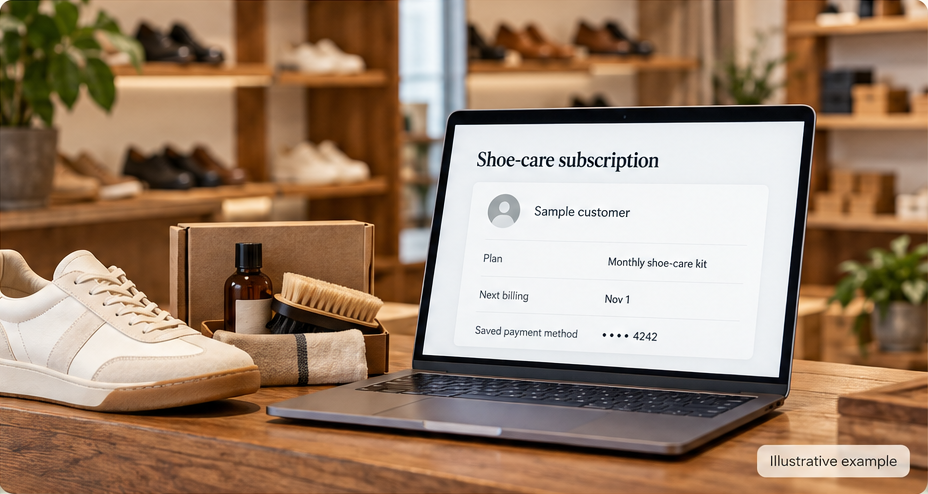
Who holds the tokens?
Confirm the vault, ownership and transfer options.
What keeps billing connected?
Review gateway and subscription-platform integrations.
How are credentials updated?
Check account updater and network-token support.
Confirm token vault, ownership and portability under applicable provider technologies and agreements. Check gateway and billing-platform compatibility before changing providers. Orchestration may reduce dependence, but does not guarantee portability; account updater and network-token support depend on providers, integrations and the payment environment.
A new payment path doesn’t automatically move saved payment methods.
Portability and credential updates depend on providers, integrations and agreements.
How Merchant Counselor helps
Your payment setup,
reviewed.
Start with what you already have. Review the connections, dependencies and tradeoffs before deciding what to change.
The scope depends on your business model and existing infrastructure.
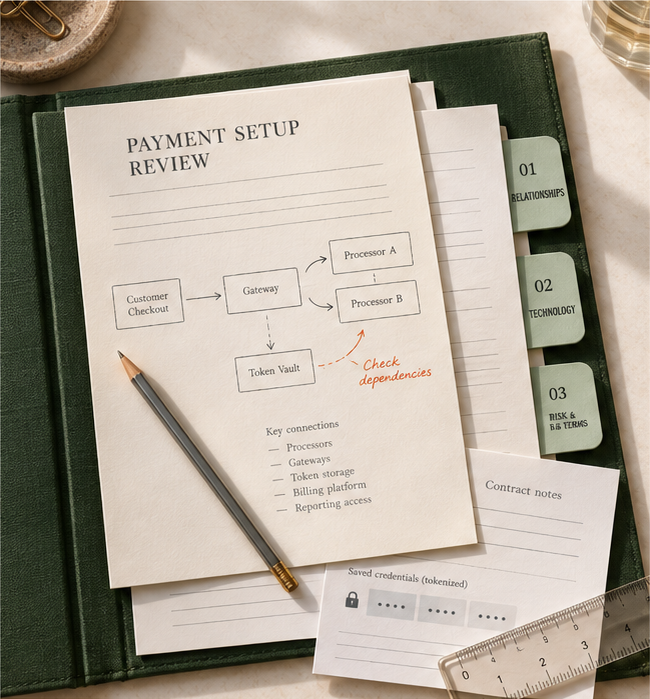
01
Payment relationships
Map your processors, merchant accounts, gateways and checkout connections.View review checklistHide review checklistProcessors, acquirers, MIDs, gateways, checkout, websites, brands, transaction types and regions / currencies.
02
Technology & saved credentials
Review billing platforms, token storage, routing rules and integration needs.View review checklistHide review checklistBilling platforms, tokenization, routing rules and integration requirements.
03
Risk, reporting & contracts
Understand your fraud tools, reporting access and contractual obligations.View review checklistHide review checklistFraud and chargeback tools, reporting, data access and contracts.
A clearer view. A more informed next step.
- 01
Understand
what you have. - 02
Identify
what’s missing. - 03
Decide
what’s worth changing.

Assess
Map the merchant's processors, gateways, MIDs, integrations, payment flows and operational requirements.
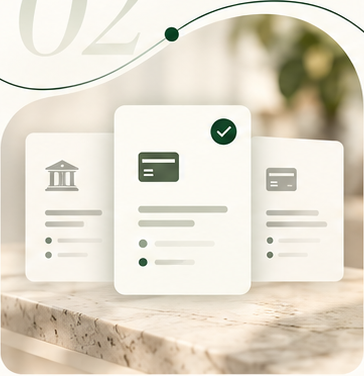
Advise
Determine whether orchestration adds meaningful value and which architecture may fit the business.
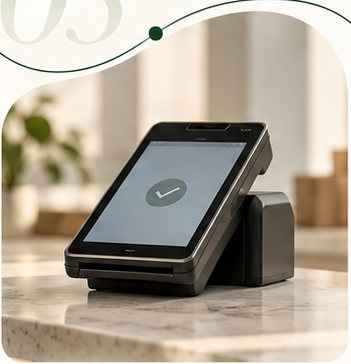
Implement
Help coordinate processors, gateways, orchestration platforms and technical teams when changes are approved.
Optimize
Measure routing outcomes, payment performance and operational impact as the environment evolves.
Do you need more control over how payments move?
We'll help determine whether orchestration is useful — or whether a simpler architecture makes more sense.
Add complexity only when it solves a real problem.