“I want to cancel.”
Voluntary cancellation

Coffee subscription
Subscription canceled
Your cancellation is confirmed.
StatusCanceled
Make leaving clear and easy.
Respect the request. Confirm the cancellation.
Subscriptions & Recurring Billing
Keep the second payment, the tenth payment and every renewal moving.

Month 1
First order
Payment approved
Month 2
Next delivery
Renewal approved
Month 3
Ready to ship
Payment declined
Each billing cycle is its own payment event. The first payment and later charges can behave differently with issuers.

Customer-Initiated
The customer starts the subscription.
At signup, the customer authorizes the first payment and agrees to store their credential.

Merchant-Initiated
The merchant submits the next scheduled payment.
Later renewals use the stored credential and appropriate recurring indicators.
Illustrative example
Sign up
First payment & credential stored
Renewal approved or declined
Appropriate next action
Measure recurring performance separately from initial checkout.
Explore Approval Rate Optimization →Cards expire, accounts are replaced and issuers update credentials. Account updater services and network tokens can help keep stored credentials current.
Updater and token capabilities depend on the provider, network, issuer, region and integration. Updates are not universal — not every credential can be updated.
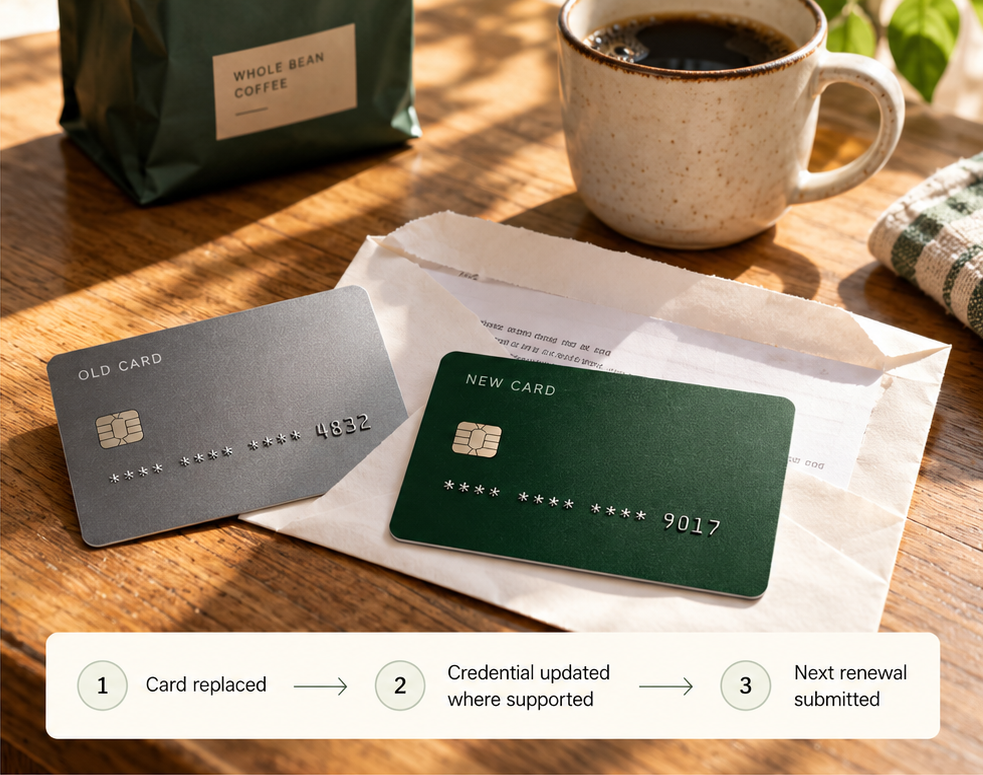
Renewals, retries & customer continuity
The right response starts with understanding why the payment was declined.

Renewal declined
Review the issuer response before acting.
Choose the next step
Wait or retry where appropriate.
Follow the issuer response and applicable retry rules.
Update payment details or contact the customer.
Check whether the stored payment method needs attention.
Stop further attempts as required.
Follow the stop instruction rather than repeating the payment.
Read the response. Then choose the next step.
There is no universal retry schedule. Appropriate action depends on the issuer response, billing model, provider capabilities and network rules.
Illustrative examples. A retry is not guaranteed to be approved.
Changing providers can mean migrating stored credentials — or asking customers to update their payment details.
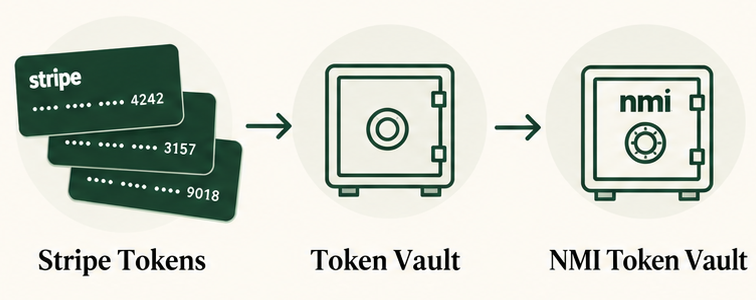
*30 days plus to migrate, if approved. Transactions processed during the migration window will not transfer.
Confirm timing and transfer scope with the providers.
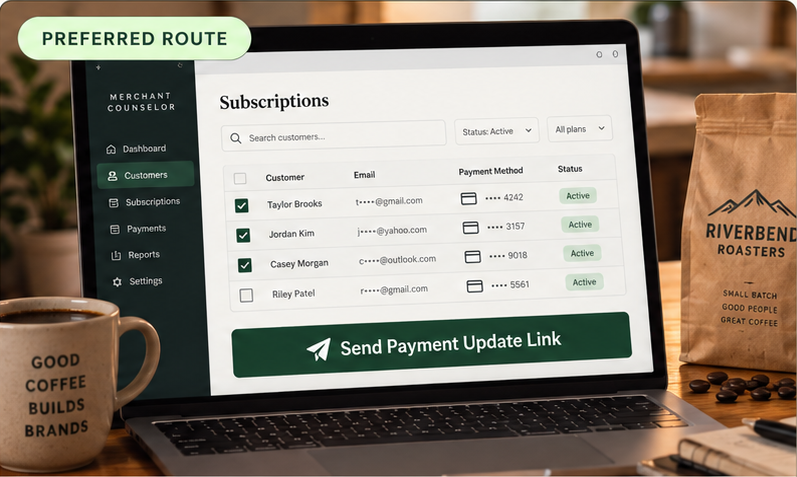
Preferred route
Faster to initiate. No waiting for token migration.
Customers still need to complete the update.
Illustrative examples. These scenario notes are not guaranteed provider service levels. Where credentials are tokenized and stored affects whether subscriptions can continue if you change gateways, processors or billing platforms.
Gateway, processor and network tokens carry different provider dependencies. Token ownership, export and migration capabilities vary by provider and integration; tokens cannot always be exported or migrated.
Explore Gateways & Token Portability →Subscriptions & customer experience
A customer who cancels and a payment that fails need different responses.
Voluntary cancellation
Coffee subscription
Subscription canceled
Your cancellation is confirmed.
Respect the request. Confirm the cancellation.
Payment failure

Coffee subscription
Your payment didn’t go through
Update your payment details if you want the next delivery.
Next step: update payment method.
Explain what happened and provide a clear next step.
Illustrative customer messages—not live account controls.
Payment recovery should never prevent customers from exercising legitimate cancellation rights.
Your next coffee renewal is approaching.
Please update your payment method.
Confirm the update or cancellation.
Illustrative examples.
Review fraud controls and chargeback risk alongside recovery. Clear receipts and recognizable billing descriptors also matter.
Change one meaningful variable. Compare what happens next.

Separate first payments from renewals.
Understand reasons and recovery outcomes.
Review updater and token activity.
Track cancellations, refunds and disputes.
Analysis depends on transaction volume, integrations and available data. Testing methods also depend on processors and billing platforms.

Map the billing platform, gateway, processor, merchant accounts (MIDs), token setup and recurring authorization performance.
Identify opportunities across retries, credential updates, token portability, architecture and customer communication.
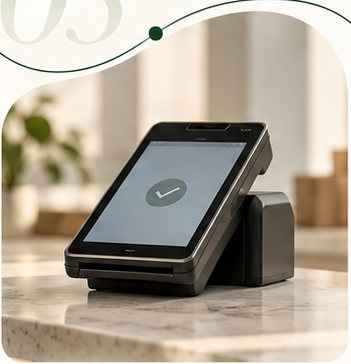
Help coordinate approved changes with processors, gateways, subscription platforms and other technology providers.

Measure recurring-payment performance and keep evaluating as volume and customer behavior change.
Architecture consideration
One processor and merchant account is often appropriate. As volume, brands or risk grow, additional MIDs or routing may deserve evaluation — subject to compatibility, underwriting and processor, acquirer and card-network rules.
Explore Payment Architecture →Understand the failure before choosing the fix.