Ecommerce Payment Processing
Online processing should fit the business behind the checkout.
Merchant Counselor helps businesses evaluate ecommerce processors, merchant accounts and payment infrastructure based on how the business actually operates.

Choose a processor that understands your business.
What you sell—and how customers pay—changes what you need.

Online retail
What the processor needs to understand
When orders ship
Time between payment and fulfillment.
How refunds work
Returns, exchanges and seasonal demand.
How the business grows
Expected volume and average order size.
Start with the business model and transaction profile.
What we compare
- Business fit
- Approvals
- Funding
- Compatibility
- Support
Account approval depends on underwriting and on what the business discloses about its model, volume and transaction profile.
Pricing & contract terms
- Transaction costs
- Recurring fees
- Contract length
- Cancellation terms
Gateways & Flexibility
Changing processors shouldn’t mean starting your store over.
Your gateway, integrations and provider agreements determine what can stay—and what needs to change.

Provider A
Provider B
- Will checkout need rebuilding?
- Can saved payment details transfer?
- Can you take your records with you?
Compatibility and portability vary by platform, gateway and provider.
Payment Performance
See where payments succeed—and where sales get stuck.
Compare payment accounts, purchase types and decline reasons to understand what needs attention.
Explore Approval Rate Optimization →Everyday Goods
Payment Command Center
- Approval rate
- 91.4%
- Approved attempts
- 914
- Declined attempts
- 86
Approval performance
Approval rate by purchase type
- First purchases94.1%
- Renewals88.6%
Top decline reasons
- Insufficient funds
- Incorrect details
- Issuer declined
Renewal approvals are below first-purchase approvals.
Review decline reasons →Funding & Cash Flow
An approved payment isn’t the same as available funds.
Sales can be approved before the money reaches your bank. Settlement timing, reserves and adjustments determine what is available to use.
Timing
When does the payout arrive?
Reserves
Is part of the payout held back?
Adjustments
What was deducted?
Refunds, disputes and chargebacks can affect payouts and funding terms.

Everyday Goods · Payout example
- Processed sales
- $10,000
- Fees & adjustments
- −$300
- Reserve withheld
- −$1,000
- Available for payout
- $8,700
Illustrative example
Your next inventory order depends on available cash—not just approved sales.
Funding terms vary. Not every merchant has a reserve or hold.
Build the right setup. Test before switching.
For many ecommerce merchants, one merchant account is exactly what is needed. Additional accounts or providers depend on business needs, compatibility and underwriting — and must follow processor, acquirer and card-network requirements.
When the technology, agreements and underwriting allow it, a proposed payment path can be tested with a limited portion of eligible traffic before anything moves.
Compare Before Expanding
- Approvals
- Funding
- Cost
- Reliability
- Risk
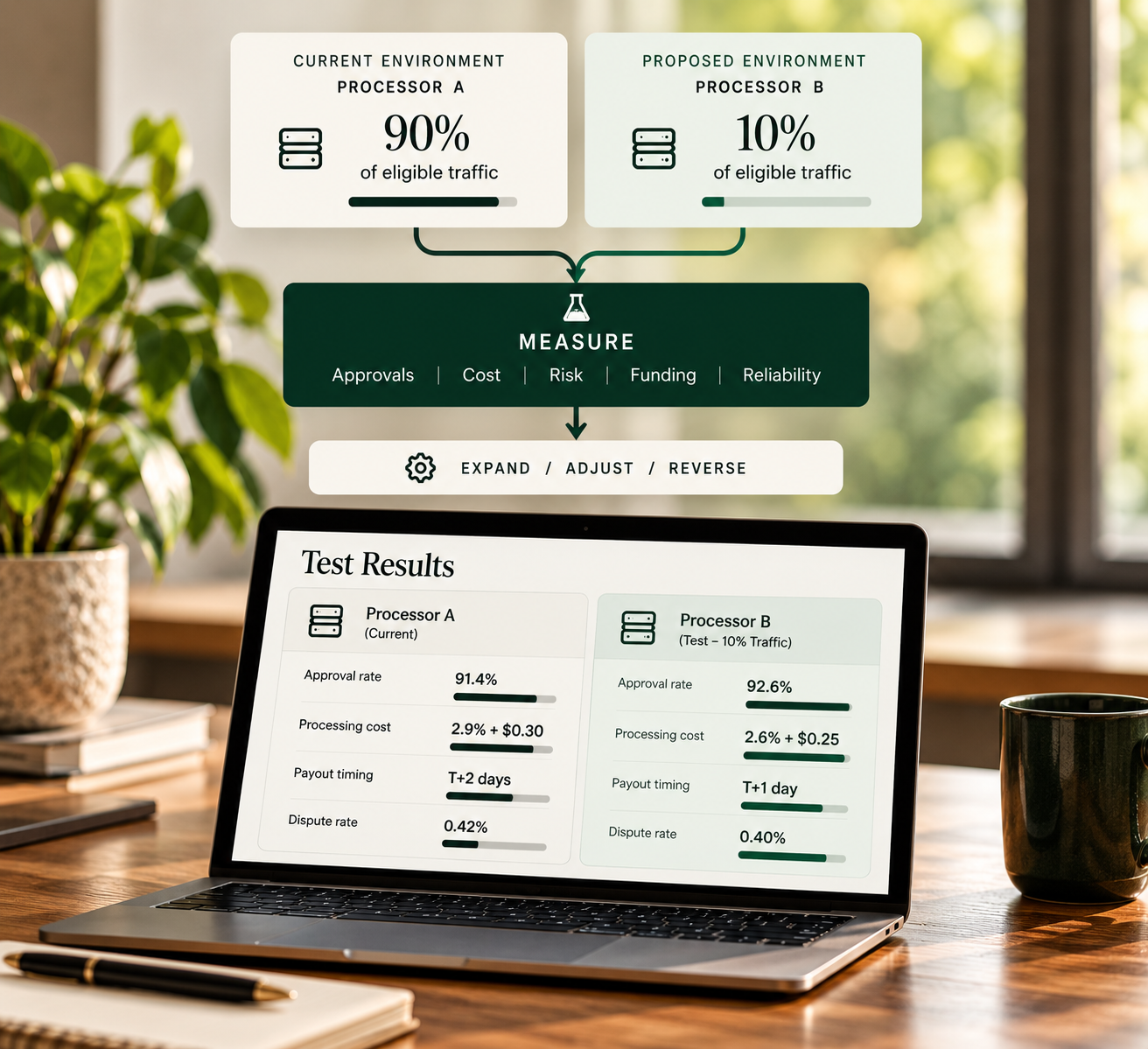
Illustrative allocation: current Processor A receives 90% of eligible traffic; proposed Processor B receives 10%. Measure approvals, cost, risk, funding and reliability, then expand, adjust or reverse. Test results for Processor A versus Processor B: approval rate 91.4% versus 92.6%; processing cost 2.9% plus $0.30 versus 2.6% plus $0.25; payout timing T+2 days versus T+1 day; dispute rate 0.42% versus 0.40%.
Figures and traffic allocation are illustrative, not actual merchant data or expected results.
Controlled testing depends on processor cooperation, transaction volume, integrations and underwriting.
A conversation about your business
Let’s find the right fit for your business.
Show us how you sell, what you use today and what you’d like to improve.
Review My Ecommerce SetupStart with your business. Then consider the options.